
GFP Expression Marker System
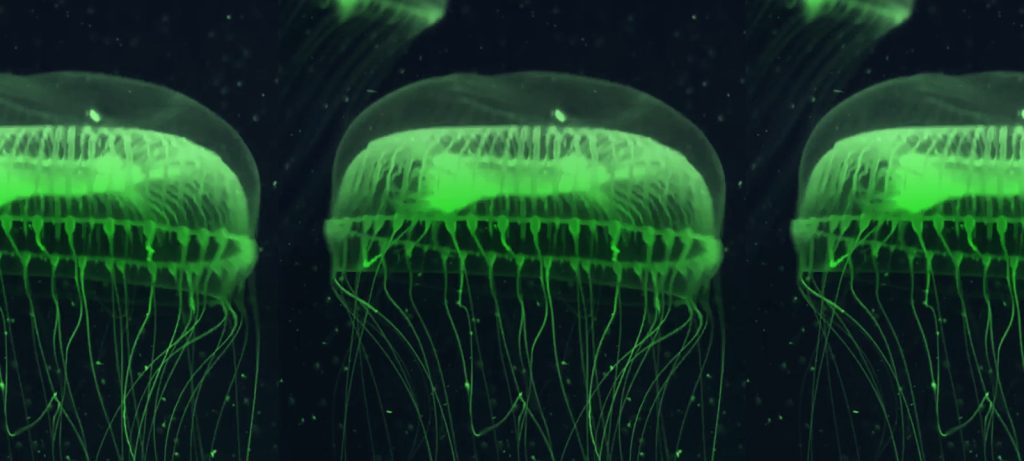
GFP Expression Marker System used green fluorescent protein, or GFP, as a visible marker in living cells. It enabled users to link GFP to a regulatory DNA element or to a protein of interest, then detect fluorescence under near-UV or blue light to monitor gene expression, select expressing cells, or localize proteins without exogenously added substrates or cofactors.
Algal Bloom Early Detection System
Patented system that detects harmful algal bloom cells early by combining non-contact Raman “fingerprints” with light field and darkfield microscopy for faster, more confident identification.
ROV Lightweight Lifting Tether System
A segmented marine tether that keeps a compact diameter for comms/power while adding a load-bearing lifting sleeve for safe launch/recovery, plus torsion control and optional “S-tether” buoyancy behavior. Enables lighter signal tethers to lift heavy ROVs safely: adds a load-bearing sleeve for in-air lift, reduces twist/hockling, and can form an “S” shape to lower tug on the vehicle.
CPICS Submersible Microscope
CPICS is a submersible microscope that captures sharp, high-resolution images of plankton and suspended particles directly in the water. It uses darkfield lighting so the camera mainly sees light scattered by the organism or particle, which makes fine features stand out. The imaging space is open and flow-through, so fragile targets can pass through naturally and stay intact. The system can also sort and label images automatically using image-quality checks, in-focus detection, and trained categories.
RadBand Seawater Monitoring Bracelet
This technology is a wearable or towable sampling device that can be immersed in water to collect chemicals of interest onto a sorbent material. It also records basic context during sampling, such as time, location, and water conditions. After deployment, laboratory analysis of what was captured on the sorbent can be used to estimate the concentration of a target substance in the water.
Submersible Interferometric Sensor
This technology reads an interferometer signal using a standard spectrometer. It calculates absolute optical path length difference with very high precision, even when the spectrometer samples are not spaced in the usual “quadrature” way. It has a resolution from 1/1,000 to 1/100,000 of a wavelength, which supports high-precision sensing of parameters like refractive index, which can be used for salinity and density.
Beacon Deployment for Underwater Vehicles
Beacon Deployment for Underwater Vehicles is a payload release system for underwater vehicles and other platforms. It holds each payload by suction (vacuum), then releases it by letting water enter a chamber, and it supports passive weight compensation while a leg assembly helps the payload stand in a functional position.